

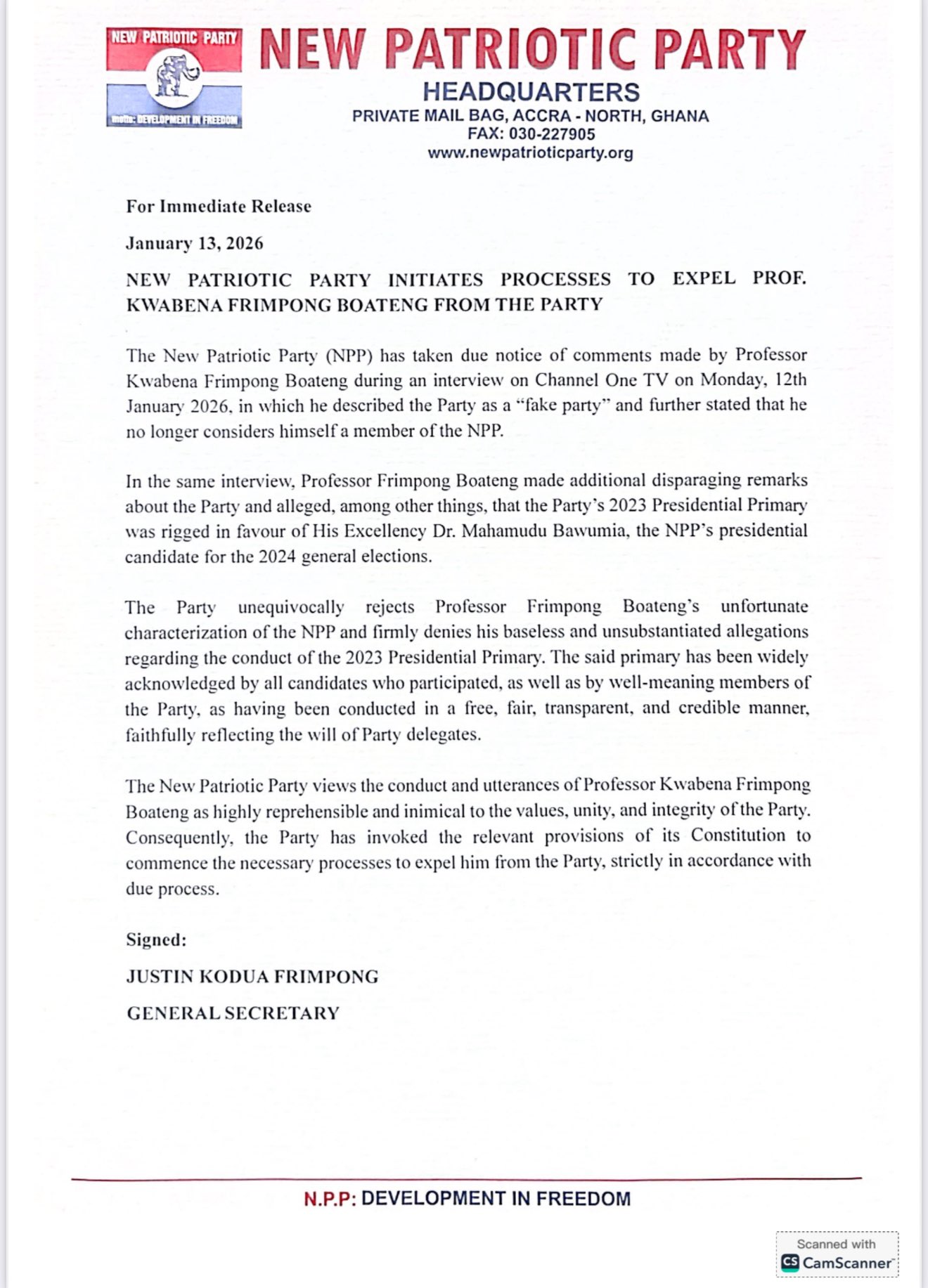
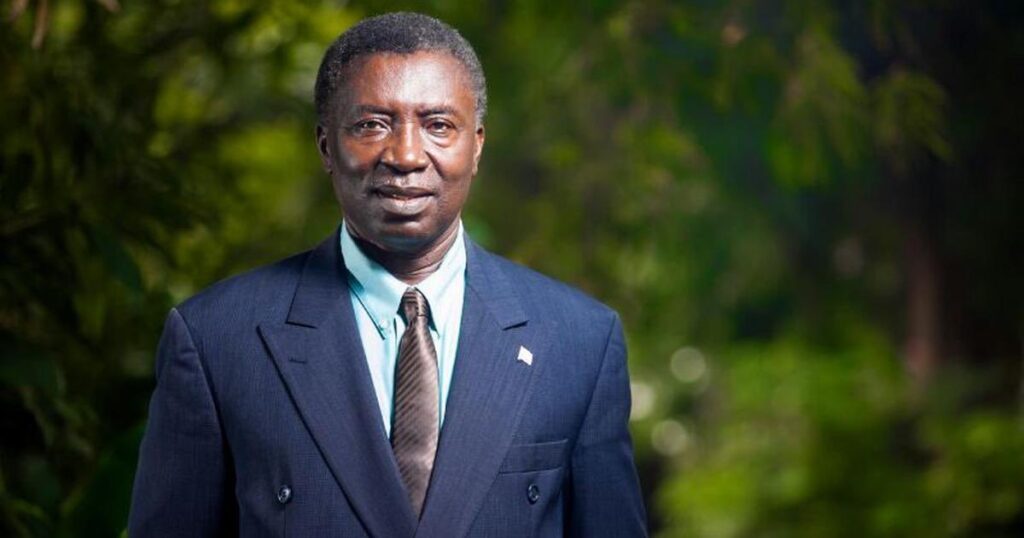
The New Patriotic Party (NPP) has formally begun internal disciplinary processes to expel Professor Kwabena Frimpong-Boateng, following comments he made during a recent television interview that the party says undermine its integrity, unity, and constitutional values. The move marks a significant escalation in tensions between the party and one of its prominent figures, drawing national attention to issues of internal democracy, party discipline, and political accountability.
In an official statement issued from the party’s national headquarters in Accra and dated January 13, 2026, the NPP confirmed that it had taken “due notice” of remarks made by Prof. Frimpong-Boateng during an interview on Channel One TV on January 12, 2026. During the interview, the former party stalwart reportedly described the NPP as a “fake party” and publicly stated that he no longer considered himself a member of the governing political organization.
Party Rejects Allegations of Rigged Primaries
Beyond questioning his membership status, the party expressed strong objection to additional claims made by Prof. Frimpong-Boateng, particularly allegations that the NPP’s 2023 presidential primary was manipulated in favour of Dr. Mahamudu Bawumia, the party’s presidential candidate for the 2024 general elections.
The NPP categorically rejected these claims, describing them as “baseless and unsubstantiated.” According to the party, the 2023 presidential primary was conducted in a manner that was free, fair, transparent, and credible, and its outcome genuinely reflected the will of party delegates nationwide.
Party officials emphasized that all candidates who participated in the primary, as well as the majority of party members, had acknowledged the process as legitimate at the time. The NPP therefore views the renewed allegations as an attempt to cast doubt on a process that has already been widely accepted within the party’s structures.
Expulsion Process in Line With Party Constitution
In its statement, the NPP described Prof. Frimpong-Boateng’s conduct and public utterances as “highly reprehensible” and fundamentally inconsistent with the party’s core values. The leadership stressed that unity, loyalty, and respect for internal processes remain central to the NPP’s identity and democratic tradition.
As a result, the party announced that it had invoked relevant provisions of its constitution to commence formal processes that could lead to Prof. Frimpong-Boateng’s expulsion. Importantly, the party noted that these steps would be carried out strictly in accordance with due process, signaling that the former minister would be afforded the procedural rights outlined in party rules.
The statement was signed by the NPP’s General Secretary, Justin Kodua Frimpong, underscoring the seriousness with which the party leadership views the matter.
Political Implications and Public Reaction
The decision to initiate expulsion proceedings has sparked widespread debate within political circles and among the general public. Prof. Frimpong-Boateng is a well-known public figure whose past roles in government and the party have earned him both respect and influence. His criticisms have therefore resonated beyond party lines, raising questions about internal dissent, freedom of expression, and discipline within political organizations.
Supporters of the NPP leadership argue that no party can function effectively if senior members openly undermine its credibility in public. They contend that internal grievances should be addressed through established channels rather than media platforms, especially during a politically sensitive period.
On the other hand, critics believe the situation reflects deeper internal challenges within the party, suggesting that the disciplinary action may discourage open debate and whistleblowing. Some political analysts see the development as part of a broader struggle to maintain cohesion within the party following competitive internal elections.
NPP Emphasizes Unity and Integrity
Despite the controversy, the NPP has reiterated its commitment to unity, transparency, and constitutional governance. Party leaders maintain that discipline is essential to preserving public trust and ensuring that the organization remains focused on its broader political and governance objectives.
The party also stressed that personal opinions, when expressed in a manner that damages collective credibility, cannot be ignored, regardless of an individual’s status or history within the organization.
What Comes Next
As the disciplinary process unfolds, attention will be on how the NPP applies its internal rules and whether Prof. Frimpong-Boateng responds formally to the charges implied by the statement. The outcome could have lasting implications for party cohesion, public perception, and internal political culture within the NPP.
For now, the situation serves as a reminder of the delicate balance political parties must strike between encouraging internal debate and enforcing discipline. With national interest firmly fixed on the matter, the NPP’s handling of the case will likely shape discussions around party governance and accountability in Ghana’s democratic landscape.