

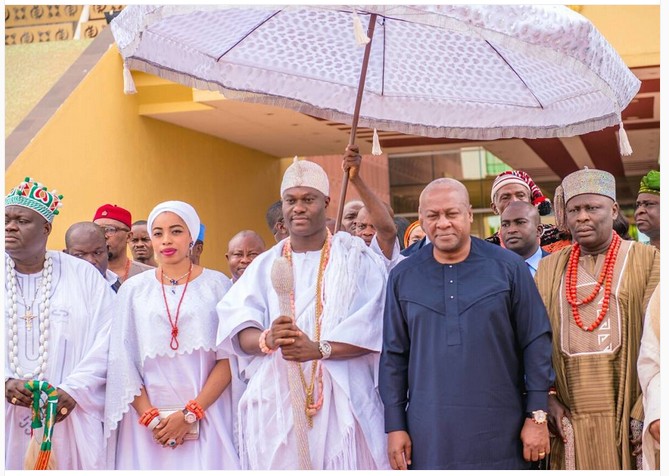
President John Dramani Mahama delivered a powerful and timely affirmation of Ghana’s regional strategy this week, asserting that the prosperity of Nigeria is intrinsically linked to the prosperity of Ghana. Speaking in Ife State, Nigeria, during a traditional ceremony where he was honoured with a Yoruba chieftaincy title, Mahama painted a picture of shared destiny between the two West African giants a message with far-reaching political and economic implications for Ghana’s future.
At the heart of Mahama’s remarks was a simple but profound premise: when Nigeria prospers, Ghana prospers; when Ghana prospers, Nigeria prospers. This philosophy, he argued, is rooted in history, cultural proximity, and deep socio-economic interdependence. According to Mahama, the two countries are not merely neighbours but strategic partners bound by common values and intertwined ambitions likening them to “twins of the same mother.”
The occasion itself is installation as Aare Atayeto Oodua of the Source by the overlord of the Ife Kingdom was symbolic. It wasn’t just ceremonial grandeur; it was an affirmation of unity between two peoples who share centuries of cross-border interaction, migration and blending of cultures. Such honours are rare for foreign heads of state and suggest that Ghana’s leadership is cultivating stronger people-to-people diplomacy as part of its continental vision.
Mahama’s statement comes at a time when Ghana’s economic landscape is undergoing scrutiny both at home and across the region. The nation is gradually emerging from a period of severe fiscal tension that dominated its political discourse in recent years. While some economic indicators have shown signs of recovery, public expectations for tangible improvements in livelihoods remain high. By reinforcing the interdependence with Nigeria Africa’s largest economy. Mahama is signalling a strategic shift: Ghana’s prosperity will be amplified through stronger regional integration, not isolation.
This perspective aligns with broader pan-African economic thinking that economic integration particularly within the Economic Community of West African States (ECOWAS) can turbocharge growth across borders. Nigeria’s vast market, manufacturing capacity and demographic heft offer opportunities for Ghanaian exporters, investors, and professionals. Conversely, Ghana’s stable democratic framework and business environment create fertile ground for Nigerian capital and enterprise. The synergy is not hypothetical; it is rooted in decades of trade, labour movement and shared aspirations for regional leadership.
But Mahama’s message also carries a political dimension. By publicly celebrating Nigeria’s rise, he is signalling to both domestic and international audiences that Ghana’s leadership is not inward-looking. It is a bold attempt to frame national development within a broader West African context a narrative that contrasts sharply with more nationalist economic strategies that prioritise exclusively domestic solutions.
Some analysts might view this emphasis on Nigeria with scepticism, arguing that Ghana must first solidify its internal economic foundations before focusing outward. They point to persistent issues such as currency volatility, youth unemployment, and public sector inefficiencies that demand urgent attention. Indeed, critics contend that a focus on external partnerships should not be at the expense of domestic problem-solving.
Yet Mahama’s line of reasoning suggests that Ghana’s potential is maximised not in isolation, but through strategic collaboration. It’s a nuanced position that acknowledges Ghana’s economic vulnerabilities while also recognising that the country does not operate in a vacuum. In a region where collective bargaining often yields greater benefits whether in trade, infrastructure development, or diplomatic influence Ghana’s alignment with Nigeria could fuel opportunities that might otherwise remain out of reach.
Furthermore, Mahama’s remarks underscore a larger political thesis: regional solidarity is not merely idealistic, but pragmatic. Africa’s economies, fragmented and under-capitalised, have historically fallen short of their potential largely due to weak intra-continental trade. By fostering stronger economic ties with Nigeria, Ghana can position itself as a key beneficiary of a more integrated West African market.
In sum, Mahama’s assertion that “when Nigeria prospers, Ghana prospers too” is more than diplomatic courtesy. It reflects a strategic vision that places Ghana firmly within a regional economic ecosystem one where prosperity is shared, not siloed. Whether this vision translates into measurable gains for ordinary Ghanaians will depend on the implementation of policies that harness the potential of this partnership. But for now, the message is clear: Ghana’s future is bound up with that of its largest neighbour a proposition that, if well-executed, could redefine regional development for years to come.